Thursday, October 12, 2006
99.9% of glaciers shrinking
Dr Georg Kaser (University of Innsbruck), President of the IUGG Commission for the Cryospheric Sciences and one of the lead authors of the IPCC 4th Assessment Report, and his team, have published the results of a global survey of glacier mass balance (Article: Kaser, G., Cogley, J. G., Dyurgerov, M. B., Meier, M. F. and Ohmura, A. 2006. Mass balance of glaciers and ice caps: Consensus estimates for 1961–2004, Geophysical Research Letters 33, L19501). The team concludes that there has been a sharp acceleration in the rate of glacier melting in the last five years and they attribute this directly to global warming. Worldwide glacier melting is likely to lead to substantial losses to water suplies for major areas of South America and Asia.


Thursday, October 05, 2006
Exploratory drilling triggers unstoppable mudflow....
A team of geologists from the University of Oslo has stated that efforts to stop the mud flowing 200m from a 2km deep exploratory borehole in East Java are "unlikely to succeed". The mud started gushing from the hole on May 29th and is continuing at a rate of 50,000m3 per day. Two villages have already been flooded and another four will probably have to be destroyed. There are suggestions that the resulting environmental devastation could reach the catastrophic proportions of the Exxon Valdez sunken oil tanker disaster in 1989, Alaska. The geological team have suggested four possible fundamental causes for the mudflow; gas-rich fluid breaching coral mounds on top of the limestone rock; gas produced from a magmatic reaction; a new mud volcano; or migration of hydrothermal fluids from nearby.
Monday, July 10, 2006
Eiger rockfall awaited
Geologists monitoring Mt. Eiger in the Swiss Alps have reported that a major fissure is opening up at the rate of 75cm per day, loosening a block of rock 2x10⁶ m3 in size. If the rockfall occurs (it is expected in the next few days), debris settling onto glaciers below could block streams and cause downstream flooding or affect water supplies, but there is no direct danger to Man or property. The report made to The Guardian blames global warming for this activity but no evidence for this is presented. It is much more likely to be part of the natural cycle of erosion and deposition occurring in the mountains.
Tuesday, April 04, 2006
Global glacier mass balance in decline
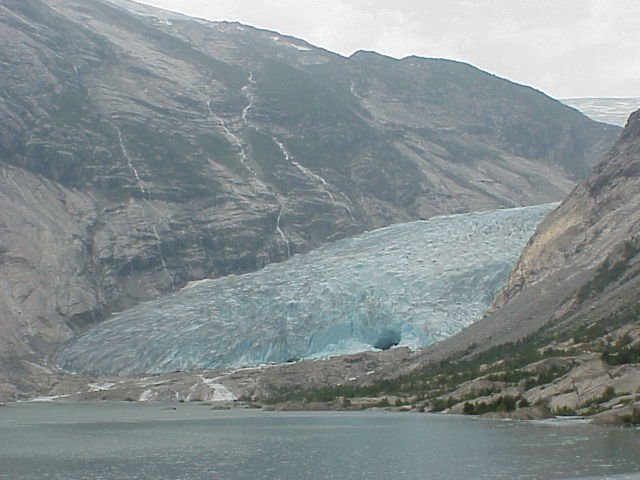 The World Glacier Monitoring Service (WGMS) based in Zurich collects and provides annual mass balance data for glaciers around the world. These data, reported by the WGMS at the recent European Geosciences Union meeting in Vienna, demonstrate a mean loss of 2.9% per decade from 1850 to 1970. This figure has increased to 8.2% for the period 1970 to 2000. Further information is available from the WGMS web site (from which mass balance data are available) and a recent BBC News report.
The image shows Nigardsbreen on the Jostedals ice cap in central Norway. This is one of the few glaciers which is currently advancing, against the gloabal trend....
Friday, March 31, 2006
Severe land degradation in Africa
A new report by The International Center for Soil Fertility and Agricultural Development (IFDC) presents findings of a programme of monitoring soil 'health' in Africa over the period 1980 to 2004. The IFDC concludes that in several countries the use of the land for agriculture is unsustainable because of nutrient depletion. This has arisen due to over-exploitation, use of marginal land and poor land management practices. The situation is exacerbated by the low usage of fertiliser in Africa which has one of the lowest rates of usage in the world.
Friday, February 17, 2006
Rain-induced landslide
Major mudslides have occurred in the Philippines, effectively submerging a village under thick mud. The death toll is still being assessed, but latest reports from the Philippine Red Cross, suggest that at least 200 people have lost their lives and as many as 2,000 are still missing. The landslides have occurred in Leyte Province, following torrential rain and flash flooding. However, while rainfall may have been the main CAUSE of the landslides, the TRIGGER may have been provided by a small earthquake according to Rene Solidum (Director of the Institute of Volcanology and Seismology in Manila). Other potential causes include logging (see report from New York Times).
Tuesday, January 17, 2006
Landslide in Dorset
On 14th January 2006 a landslide occurred near Charmouth in West Dorset and 17 people had to be rescued from rising tides due to the landslide debris. The landslide has destroyed more of the coastal path and new cracks have opened up in the fields above, indicating further activity is to come. The area is prone to landsliding because impermeable Jurassic clays and limestones underly permeable Cretaceous Greensand. Following prolonged rainfall, the accumulation of percolated water at the boundary between the two formations causes seepage, lubrication and a consequent loss of friction. The result is that the upper strata slide over the underlying strata.
For more information on the geology and landsliding along this stretch of coast, visit the Jurassic Coast web site
For more information on the geology and landsliding along this stretch of coast, visit the Jurassic Coast web site
Tuesday, December 06, 2005
World's tallest building triggers earthquake?
The world's tallest building, Taipei 101, situated in Tawain, is being blamed for the increased number and magnitude of earthquake tremors that have occurred beneath it. The building, situated on soft sedimentary rocks, is 508m tall and exerts 0.5Mpa on the ground. It has been argued that these stresses are transferred 10km down to the upper crust and have re-activated an ancient fault. Although the number and magnitude of earthquake tremors have increased since construction commenced, some argue that this could simple reflect short-term variability in the natural cycle of events. Others also argue that stresses cannot be transferred to such a depth below the Earth's surface. Furthermore, the total load applied to the ground by Taipei 101 is negligible compared to some stuructures such as dams. What do YOU think?
Tuesday, October 11, 2005
Natural disasters producing environmental refugees
According to the United Nations University, there are likely to be 50 million worldwide environmental refugees by 2010. The main sources of refugees are land degradation due to unsustainable land management; and flooding, exacerbated by global warming. The UNU have calculated that the number of refugees created by natural disasters exceeds that produced by war and conflict. The problems are likely to increase as environmental refugees join poor, squatter communities in urban areas.
Wednesday, August 31, 2005
Rapid glacier retreat in Peru
 The Peruvian tropics are host to many Andean glaciers. These are retreating rapidly due to global warming and it is anticiapted that all glaciers below 5500m will have melted in just TEN years time. The population of Peru mainly occupies a strip of arid desert lying between the oceans and the Andean mountains, and rely on glacial meltwater for their primary water supply. This meltwater supplies domestic, industrial and agricultural uses as well as providing a key source of hydroelectric power. The future for Peruvians looks gloomy.
Friday, August 12, 2005
Massive permafrost thaw in Siberia
The sub-Arctic region of western Siberia, an area spanning more than a million sq km, is undergoing permafrost thaw on a scale previously unprecedented. The delicate climatic threshold which maintains permafrost has been breached. As this essentially frozen peat bog thaws it will potentially release sufficient quantities of methane (a greenhouse gas considerably more damaging than CO2) to significantly raise global temperatures. Climatologists are said to be 'alarmed' at the finding by Sergei Kirpotin (Tomsk State University, western Siberia) and Judith Marquand (Oxford University). Further details can be found in The Guardian and New Scientist (11th August 2005).
Tuesday, August 09, 2005
Tsunami warning system for Indian Ocean countries
It has been agreed by countries flanking the Indian Ocean that a system of seabed sensors and sea-level buoys will be established to warn of potential tsunami threats. While installation of these various devices is expected to take until summer 2006 to be fully operational, the earliest sensors could be in place by December 2005.
Wednesday, August 03, 2005
Soil erosion produces biggest desert in Europe
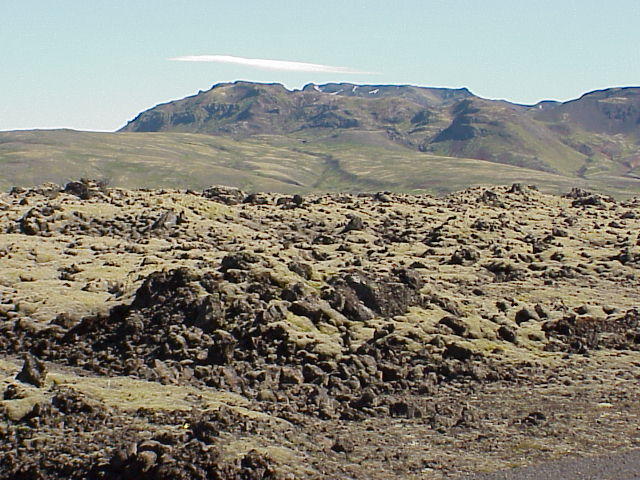 Centuries of unmanaged sheep grazing in Iceland has produced the biggest desert in Europe. Over 60% of the country is officially classified as desert, though the sand here is black and there is no shortage of water. Andres Arnalds, the Deputy Director of the Soil Conservation Service in Iceland, warns that desertification will happen elsewhere in the world where trees are being cleared and land is being over-used.
Friday, July 22, 2005
Soil erosion a threat to China
A national survey of China in 2004 found that soil erosion has impacted upon 37% of the total area of China. In response to this increasing threat a new, wide-ranging investigation involving more than 200 scientists and policy-makers has been launched (5th July 2005). The aim will be to determine the seriousness of the problem, raise public awareness and develop key strategies to curb erosion.
Useful link: WASER (World Association for Sedimentation and Erosion Research) http://www.waser.cn/default.asp
Useful link: WASER (World Association for Sedimentation and Erosion Research) http://www.waser.cn/default.asp
Monday, July 18, 2005
Bluebird Canyon Landslide
On 1st June 2005, Bluebird Canyon in California experienced a landslide. It would appear that exceptionally heavy rainfall during the winter period (esp December to February) was the underlying cause of the instability. It is thought that gradual movement of this water into and through the ground caused an unusual increase in groundwater level, subsequently leading to instability. There is concern that the area upslope of the current landslide may enlarge in the coming weeks and months.
Friday, July 15, 2005
Himalayan glaciers 'melting fast'
The World Wide Fund for Nature (WWF) says that hundreds of millions of people in the Himalays could be affected by severe water shortages because mountain glaciers are melting due to global warming.
Landslides hit north-east India
On 26th May 2005, after torrential rainfall, a number of landslides occurred in Nagaland in north-east India. The slides killed at least 10 people and many houses have been destroyed or damaged.
Subscribe to:
Posts (Atom)
